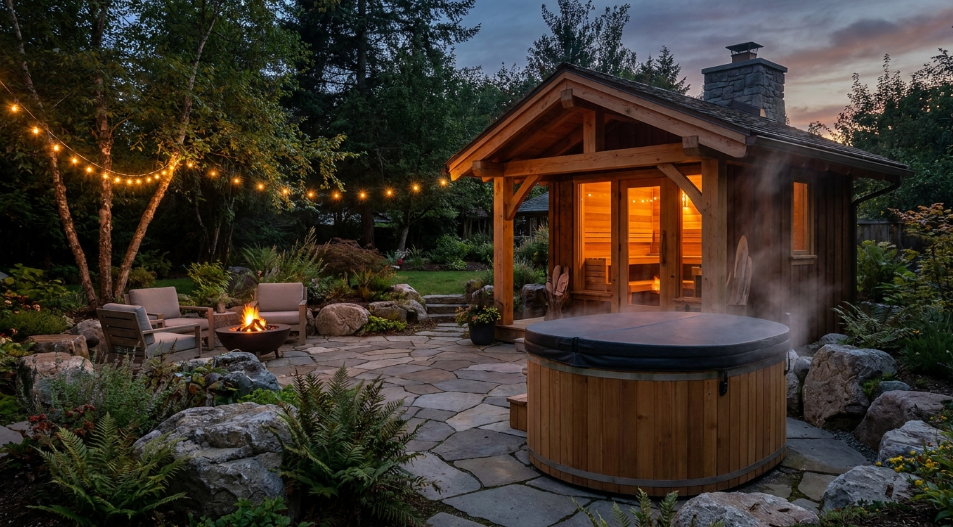
A barrel sauna handles a hard winter well if the heater is sized up for the cold, the door seal is tight, and the curved roof is left to do what it does naturally: shed snow instead of holding it. Owners in genuinely cold regions often use their barrel more in winter than summer, since the contrast between the hot interior and freezing air outside is part of the appeal. Here is what actually changes about running one once the temperature drops.
Step 1: Size the Heater for Your Actual Winter, Not the Catalog Chart
Heater sizing charts are usually built around a moderate outdoor baseline. In a climate that spends weeks below freezing, a heater matched exactly to that baseline chart will run longer, work harder, and sometimes fail to hold peak temperature on the coldest nights. If a manufacturer’s chart puts your 7-foot barrel at a 6 kW electric stove for a standard climate, sizing up to 7 or 8 kW gives the heater room to recover the heat that a curved cedar wall loses faster in subzero air than the chart assumes.
Step 2: Check the Hoops Before the First Hard Freeze
This step has no equivalent in a framed cabin sauna. Barrel construction relies on steel hoops compressing vertical staves tightly enough to seal the joints, and wood contracts slightly as humidity drops in cold, dry winter air. A hoop that was snug in September can loosen by December. Most kits include a simple tightening bolt or turnbuckle on each hoop; walk the barrel and give each one a check before the first hard freeze, then again midwinter, since a loose hoop shows up as a faint whistle of cold air along a stave seam long before it becomes an actual leak.
Step 3: Seal the Door and Check the Vent Baffle
A barrel’s round door opening depends on a continuous gasket to seal against the curved frame, and that gasket compresses less effectively once it’s cold and stiff. Inspect the weatherstripping in late fall and replace it if it’s cracked or flattened, since a poor seal at the door loses more heat proportionally in a barrel than in a larger cabin simply because the interior air volume is smaller to begin with. Close or adjust the intake vent baffle, if your model has one, to reduce the amount of subzero air pulled in during warm-up, then reopen it partway once the cabin is at temperature so fresh air still cycles through.
Step 4: Protect the Cradle Stand From Frost Heave
A barrel sits on a steel cradle stand rather than a flat sill, and that stand needs to rest on a base that won’t shift as the ground freezes and thaws. A gravel pad excavated below the frost line, or a set of concrete deck blocks set on compacted gravel, resists frost heave far better than bare soil or a thin paver layer laid straight on dirt. If your barrel was installed on a base that wasn’t built with frost in mind, check the stand’s level each fall, since even a small seasonal shift can throw the door out of square and strain the hoops over several winters.
Step 5: Clear a Safe Path and Keep the Water Bucket Inside
The walk from your back door to the barrel matters more in January than July. A shoveled or salted path prevents the kind of fall that happens stepping off a hot sauna floor onto icy pavers. Bring the water bucket and ladle back into the house between sessions instead of leaving them in the barrel, since standing water left outside can freeze and crack a plastic bucket or split a wood one. If your barrel has a small covered porch or canopy over the door, that overhang earns its keep in winter by keeping snow off the entry step.
Step 6: Budget a Little More for Running Cost, and Buy the Right Build for Your Climate
Expect a moderate rise in per-session electricity cost once the heater is working against a bigger temperature gap, though a well-sealed, correctly sized barrel shouldn’t see costs spike dramatically. The bigger factor is the barrel’s build quality going in: double-layer insulated staves hold heat noticeably better through a hard winter than a single-layer budget kit, and it’s worth confirming construction details directly with a dedicated sauna retailer before ordering if you live somewhere winters regularly drop well below freezing, rather than assuming every barrel on the market is built the same way underneath the cedar.
Step 7: Watch the Roof Seam for Condensation
The gap between a hot interior and below-freezing exterior air can produce condensation where the curved roof panels meet the top hoop, a spot that’s easy to overlook since it sits above eye level. Over several winters, unmanaged moisture at that seam can work into the wood grain and cause slow rot that isn’t visible from inside or outside until it’s fairly advanced. Check this seam each fall for any darkening or soft spots, and confirm your barrel’s roof was built with a proper vapor-managing layer between the outer and inner wood if you’re in a genuinely cold, humid climate, rather than assuming every kit handles the detail the same way. It costs nothing but a five-minute look with a flashlight, and it’s the kind of small check that saves a much bigger repair down the line.
What the Research Says About Cold and Sauna Bathing
Physiological research on heat and cold exposure, including a review published in the American Journal of Physiology, describes how the body adapts to repeated heat stress and the subsequent contrast with cold air, a pattern that lines up with how cold-climate sauna owners actually use their units. A broader review in Mayo Clinic Proceedings found regular sauna bathing associated with a range of cardiovascular benefits across climates and seasons, though this is association from observational data rather than proof that winter use specifically changes outcomes. Nothing about a hard winter changes the underlying evidence, only the mechanical demands on the heater and the build.
Frequently Asked Questions
Do barrel saunas hold up well in freezing winters?
Yes, generally better than a flat-roof structure, since the curved roof sheds snow on its own, though hoops and stave joints need a seasonal check.
Do the metal hoops on a barrel sauna need winter maintenance?
Check them once or twice a season. Wood shrinks slightly in cold, dry air, so a quarter turn on the tightening mechanism in fall and midwinter is usually enough.
Does a barrel sauna need a bigger heater in winter?
Often yes. Many cold-climate buyers size one step up from the standard chart recommendation for their barrel’s cubic footage.
Can you leave a barrel sauna’s water bucket outside in freezing weather?
No. Bring the bucket and ladle inside between sessions so standing water doesn’t freeze and crack it.
References
- Effects of heat and cold on health, with special reference to Finnish sauna bathing (American Journal of Physiology, 2018)
- Cardiovascular and Other Health Benefits of Sauna Bathing: A Review of the Evidence (Mayo Clinic Proceedings, 2018)
- Benefits and risks of sauna bathing (The American Journal of Medicine, 2001)
- National Fire Protection Association